

Issue 35: In Minor Keys
In tonalità minori, in Moll, en tonalités mineures
The Unlikely Guide un-stacks the Venetian lagoon every week and celebrates it in all its complexity. It’s a declaration of love to the local people, to the fish, the artichokes, to the Lido, to Murano, to Sant’Erasmo, and to the mud. It is composed under various headlines and features science fiction, fiction, Biennale reports, and the History Channel with stories and myths from the lagoon.
Here we go, Number 34:
Bye bye, Venezi
First, some good news: Venezia FC will be back in Serie A next season. They secured promotion last week in La Spezia. And now there’s just one game left—on Friday here at the stadium against Palermo. It was pretty much a sure thing this time. They’ve been in first spot for weeks and are playing really well.
The second piece of good news is that we saw Mimmo, the cheerful dolphin from the lagoon. With our own eyes. He was swimming alongside the ferry from the Lido to Tronchetto, just after we’d been wondering where he was. Whether he’d survived it. But he’d simply vanished from the news. And had been pushed aside by Timmy, the humpback whale in the Baltic Sea and symbol of our world that has run itself aground on every possible sandbar. But he, too, has now disappeared. Gone! After they had named him ‘Hope.’ That was perhaps the decisive mistake. And now everyone is blaming each other.
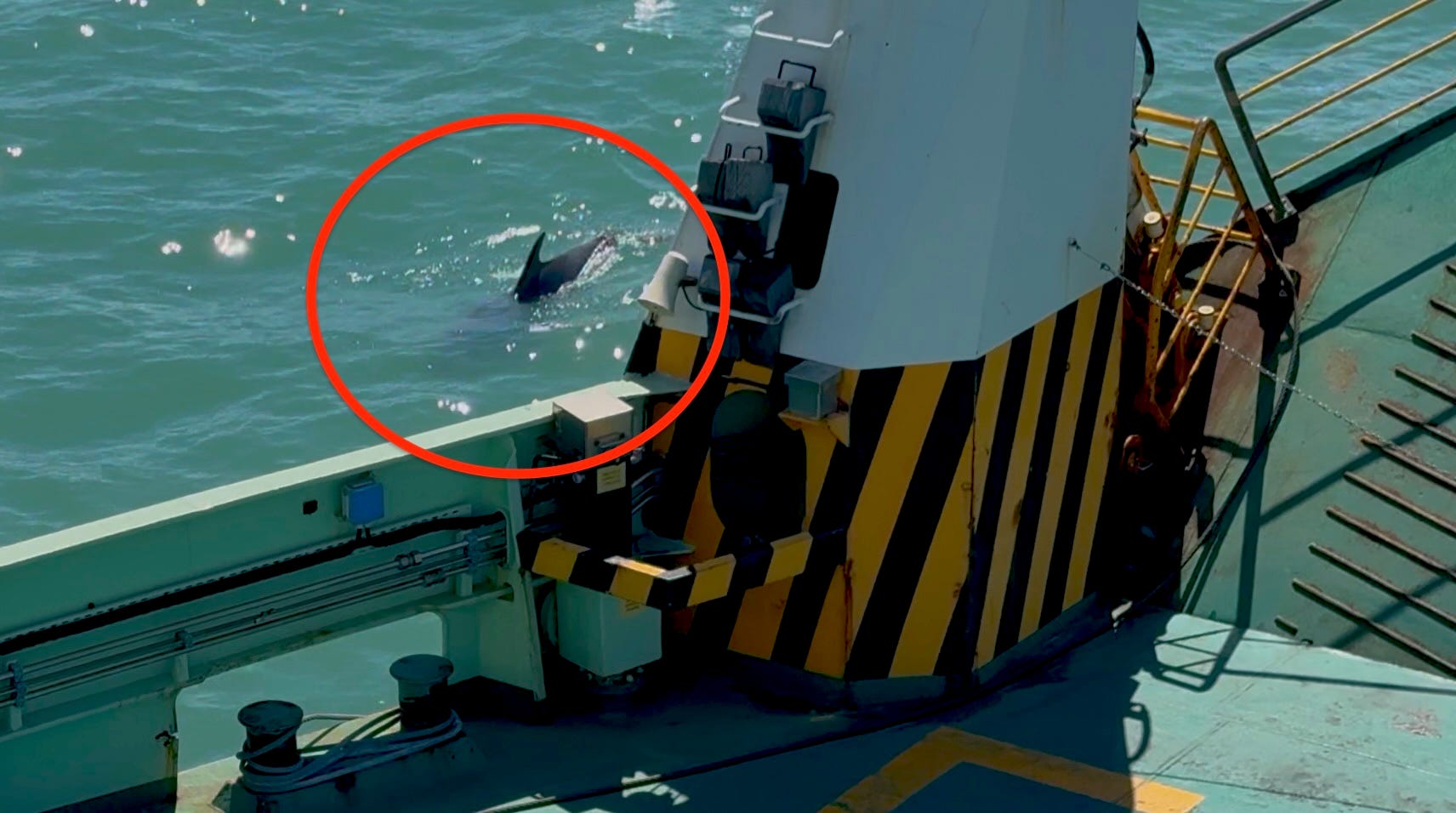
Mimmo, on the other hand, is a solitary dolphin who gets along just fine without a party, a herd, a pod, or a family. And so far, he seems to be quite clever at staying away from ship propellers. In D major. Don’t name him Hope or Freedom or Happy please.

The next piece of good news is that conductor Beatrice Venezi has been fired from the Gran Teatro La Fenice in Venice. She is a friend of Prime Minister Giorgia Meloni’s and was pushed through by the right wing, against the wishes of the orchestra and the audience. La Fenice! Where Maria Callas, la Divina, made her debut in ‘Tristan und Isolde’ in 1947. It’s a bitter defeat for the right. After seven months of struggle that shook the city. And here, mayoral elections are coming up end of May. Luigi Brugnaro is not running again! This is old news, but still very good news. The Venezi affair has certainly helped the center-left candidate Andrea Martella. The Democratic Party senator is supported by the Greens, the Five Star Movement, the Radicals, the Socialists, and several civil society groups. After 11 (the sacred number of Carnival) gloomy years under Brugnaro, who has been implicated in all manner of corruption scandals. No one can stand him anymore. But the fact that the musicians, the workers, and the audience prevailed against Venezi, against the mayor, the artistic director Colabianchi, and the Minister of Culture Alessandro Giuli has unleashed a wave of energy. Now they want the others to go, too. Colabianchi will have to resign as well. Minister of Culture Guili is also in a difficult position. He had already announced that he would not attend the opening of this year’s Biennale. In Minor Keys. Then the official opening ceremony was canceled anyway.


Instead Guili sent four inspectors from the Roman Collegio, the state cultural oversight agency, to the Biennale’s headquarters at Ca’ Giustinian. Almost at the same time, Glenn Micallef canceled his visit for this year. He said he would not set foot in the Giardini “as long as Russia is invited.” He is the EU Commissioner for Culture. The EU had already frozen a 2 million euro grant for the Biennale. Precisely because of Russia. But the interesting thing is that the inspectors hadn’t come because of the Kremlin Pavilion at all. Which is what everyone initially thought. Because the Minister of Culture Giuli was opposed to the decision by Biennale President Pietrangelo Buttafuoco to allow Russia to exhibit. No, they were here because the Israeli-Romanian artist Belu-Simion Fainaru had sent a warning letter to the Biennale Foundation, in which he invoked the European Court of Human Rights and threatened legal action. “I am a victim of racial discrimination” and, of course, “anti-Semitism.” Because they didn’t want to consider him for the prizes. Along with the Russian artists. The jury had decided that. The two countries whose heads of state are charged by the International Criminal Court with crimes against humanity were to be excluded from the prizes. Actually quite smart, after hundreds of Biennale participants had signed a petition against Israel’s participation. And the Israeli government announced it would do in Lebanon what it did in Gaza. Israel’s pavilion is being renovated anyway; the transition is in the Arsenale. It’s just the prizes, after all. It’s just the Biennale. But the outcry was, as always, huge. In minor keys. The artist Belu-Simion Fainaru exhibited at the Romanian Pavilion back in 2019, along with two others. His work was a tree that spoke—an interactive tree. And then, if anyone remembers, you walked into the next room and there was a black liquid on the floor. Unfinished Conversations on the Weight of Absence, it was called.
Back to last week: On April 30, nine days before the opening all five jury members resigned: chairwoman Solange Farkas, Zoe Butt, Elvira Dyangani Ose, Marta Kuzma, and Giovanna Zapperi. The jury had been appointed by the curator of the Biennale Koyo Kouoh, who subsequently passed away. Her team was supposed to take over after her death, but instead, the rather clumsy yet equally vain president Buttafuoco stepped into the void. The real problem with the world is that we no longer have any Latin scholars, Buttafuoco said in his first interview after the announcement that the Russians were coming: “…we were looking for a good Latin scholar and we still haven’t found one. It occurred to me that until the 1980s, you could find plenty of Latin scholars in Parliament. This speaks volumes about the vitality of the social fabric…” The problem, however, is rather that Buttafuoco always claims art is free and would heal wounds and transcend borders and foster freedom and peace, but just at the moment when he could have saved this Biennale, by preventing the official Kremlin artists from coming, his vanity stood in his way. Or his love for Russia, his Eurasian dream. He could have made up some excuse. By simply pointing out a security risk. A bureaucratic problem.
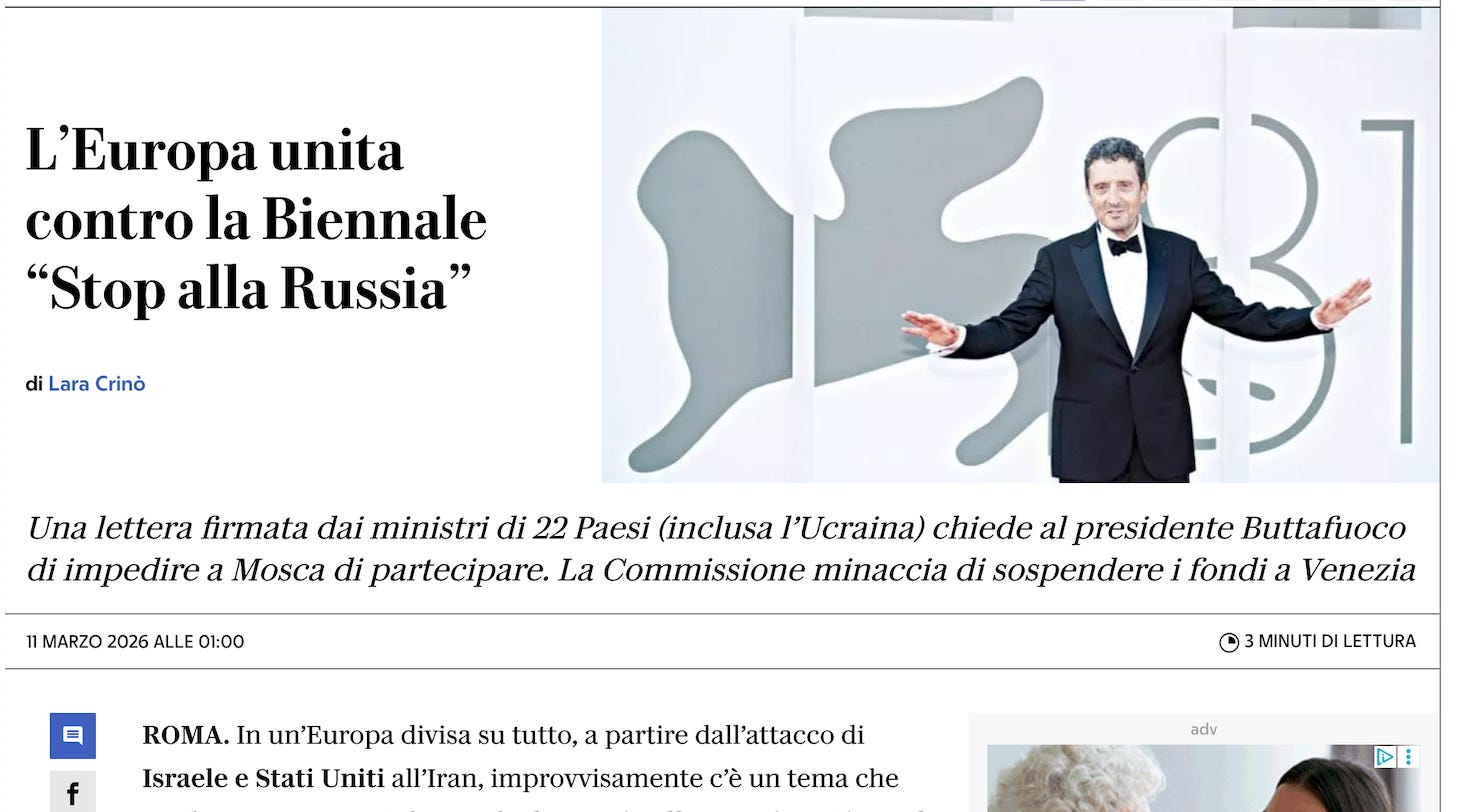
Pietrangelo Buttafuoco is in Matteo Salvini’s Lega party. The same goes for Alberto Stefani, who has been president of the Veneto Region since last December and is one of three members of the Biennale’s supervisory board. The Biennale’s vice president is Mayor Brugnaro. Another member is the former television journalist Tamara Gregoretti. She is supposed to represent the Ministry of Culture. But Minister Giuli wanted to get rid of her after she did not inform him that Buttafuoco was inviting the Russians. The minister failed and Gregoretti is still on the board.
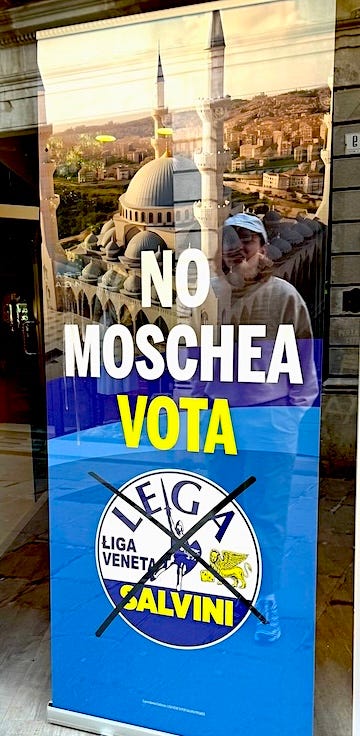
When the jury stepped down last week, the Biennale board postponed the award ceremony until the end of the exhibition, November 22. It will not be an expert jury that selects the best participant or the best pavilion, but the public. Matteo Salvini celebrated the decision. He called it “truly democratic.” Besides art, democracy is Salvini’s field of expertise. But that’s not all: Israel and Russia were once again admitted to the competition. Hahahahahaahaaha.
The newspaper La Repubblica quoted the Biennale’s lawyer, Debora Rossi, from the Roman Collegio inspectors’ report: “that the jury had been informed not only of the media reactions against the Biennale, but also of their personal risk of being held liable for damages not only to the plaintiff”—the artist Belu-Simion Fainaru—“but also to the foundation.” This is what the Biennale’s lawyer told the inspectors!! A jury that is held liable to the Biennale?
Giorgia Meloni was kept informed of every move. Almost in real time. And she stayed completely out of it. Sure, Meloni is in a tough spot herself. She lost the referendum. She can’t be seen with Elon Musk anymore. Donald Trump and JD Vance got a few slaps on the wrist from the cool Pope Leo. Trump started the war in Iran, which isn’t very popular here either. None of this is good for her. Gas has gotten super expensive. Even the old tricks don’t work anymore. Blame the EU. Now Orbán is gone, too. Meloni then suddenly allied herself with Ukraine. Private photos with Zelenskyy. She’s afloat.
Then, in her speech to the Chamber of Deputies, she tells the opposition: “I challenge you to a substantive debate. Italians have the right to know what proposals are on the table. On the merits of the international crisis, on the merits of the risks to energy supply, on the merits of a Europe that cannot regain real relevance… Let’s talk about solutions; let’s see who has them.” Is this how someone in charge of the government speaks? Someone who has a program or an idea? Opposition leader Elly Schlein responded quite cleverly: “You challenge us, but you have already lost that challenge because you defied the Constitution, and the sovereign people defeated you at the polls. (…) It’s clear you’re eager to return to the opposition; don’t worry, we’ll grant you your wish.” Pretty good, isn’t it?
The recently deceased philosopher Jürgen Habermas wrote: “Democracy depends on the belief of the people that there is some scope left for collectively shaping a challenging future.” If this belief is not upheld, if ruling politicians turn against democratic institutions in a hostile manner, if they use their position in government to oppose the state—as almost all far-right figures do—it is hard to imagine a better future. But as the philosopher Wolfram Eilenberger writes in his beautiful new book, The Presence of Philosophy: A Roadmap, which has just been published in German: “If something is a labyrinth, it will also have an exit.” Mimmo knows that. But he feels quite comfortable in the labyrinth. Ciao ragazzi, see you soon! With #36. And don’t call it Hope!
"Ich gestehe es: ich
Habe keine Hoffnung.
Die Blinden reden von einem Ausweg. Ich
Sehe.
Wenn die Irrtümer verbraucht sind
Sitzt als letzter Gesellschafter
Uns das Nichts gegenüber.“
Bertolt Brecht (um 1920)
Bertolt Brecht, DEN NACHGEBORENEN (Um 1920), in: Gedichte 3, Gedichte und Gedichtfragmente 1913 – 1927, GBFA 15, Aufbau Verlag Berlin und Weimar, Suhrkamp Verlag Frankfurt am Main, S.189
I confess: I
have no hope.
The blind speak of a way out. I
see.
When the errors are exhausted,
Sits as our last companion
Nothingness opposite us.
"This Poem was written at the very beginning of the Twenties. If not earlier. (111)" 111 „Brecht noted in the Fifties on the original typescript that this was one of his very earliest poems.“ Antony Tatlow, Critical perspectives: the European tradition, in: Antony Tatlow, The Mask of Evil, Brecht's Response to the Poetry, Theatre and thought of China and Japan, A Comparative and Critical Evaluation, Peter Lang, Bern Frankfurt New York 1977, p. 46 (Typoskript BBA 352/08