

Issue 30: La Biennale
All'ombra del Leone.
The Unlikely Guide un-stacks the Venetian lagoon every week and celebrates it in all its complexity. It’s a declaration of love to the local people, to the fish, the artichokes, to the Lido, to Murano, to Sant’Erasmo, and to the mud. It is composed under various headlines and features science fiction, fiction, Biennale reports, and the History Channel with stories and myths from the lagoon.
Here we go, Number 30:
our last critical edition (for now)
Ciao! First of all, this is our last critical edition, the third, the 30th overall. Then there will be two more non-critical or quarter-critical editions, rather irregular, and then we will take a break with the newsletter. We don’t know how long yet. But during the break, we will take care of the lists. We have promised them often, but so far only one has been published: the Scarpa list(s) in the notes.
Today, however, we will focus on the Biennale. Not the current Biennale, perhaps a little, but the institution itself. It influences all areas of life here. It is an incredible force. A machine. It determines the rhythm of many people’s lives. In May, when the art or architecture exhibitions open, or from late August to early September, when the Mostra takes place on the Lido, everything is in a state of emergency. That is when the money is made. Everything has to work. And at the same time, or perhaps precisely because of this, there are many Venetians who have never been to a Biennale.


It was founded in 1895 as the ‘Esposizione Internazionale d’Arte di Venezia’ and was one of the world’s first international art exhibitions. And there was the first scandal. ‘Il Supremo Convegno’ depicted the interior of a church with five naked women surrounding the open coffin of an imaginary dead Don Juan. The Patriarch and later Pope Pius X condemned Giacomo Grosso’s work. However, a commission appointed by the mayor saw no violation of public morality, and the painting was exhibited well hidden. But the public flocked to see the scandal. The painting was purchased by an American company and was lost in a fire on the ship that transported it across the Atlantic. So, initially works were sold at the Biennale; the German pavilion was the Bavarian one, and only over time did other disciplines join in. The architecture alternates with art every two years, and the film festival on the Lido, called ‘Mostra,’ has been around since 1932, making it the oldest annual film festival in the world. Then, in the 1930s through the 1980s, dance, theater, and music were added. Oh yes, and the carnival, which we mentioned earlier. And now there will be a large Biennale archive, which was previously in Mestre.


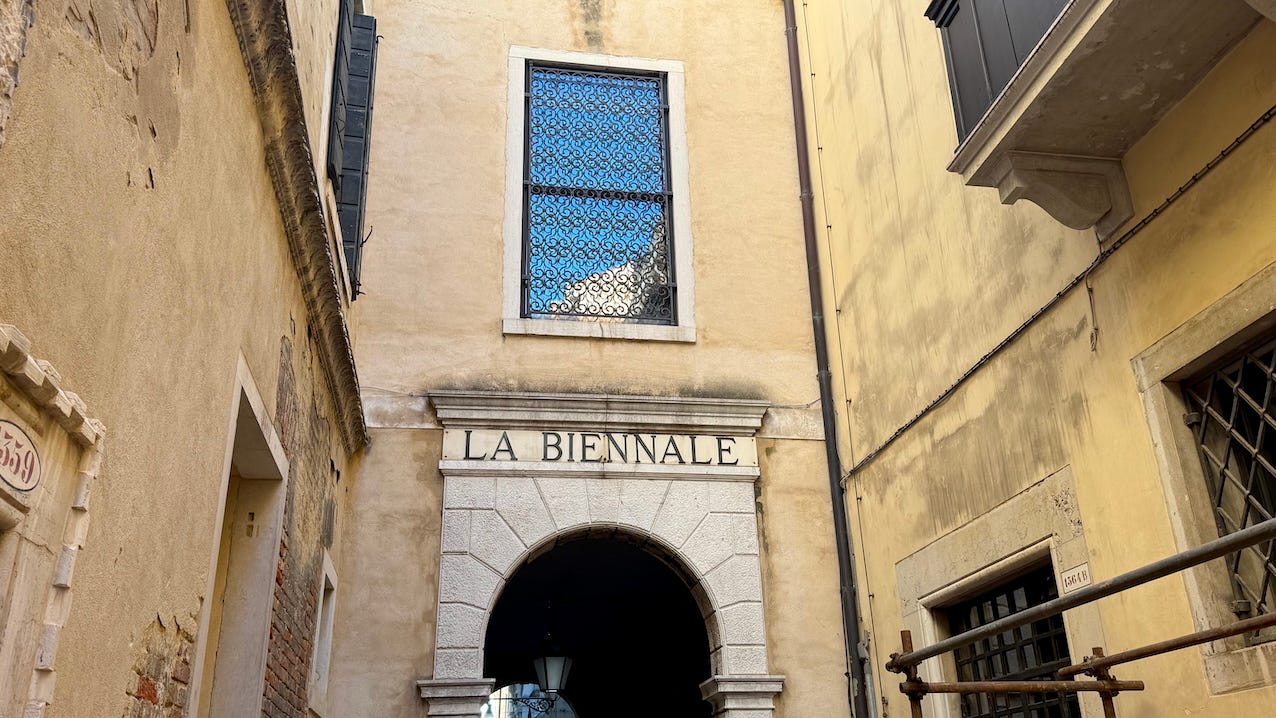
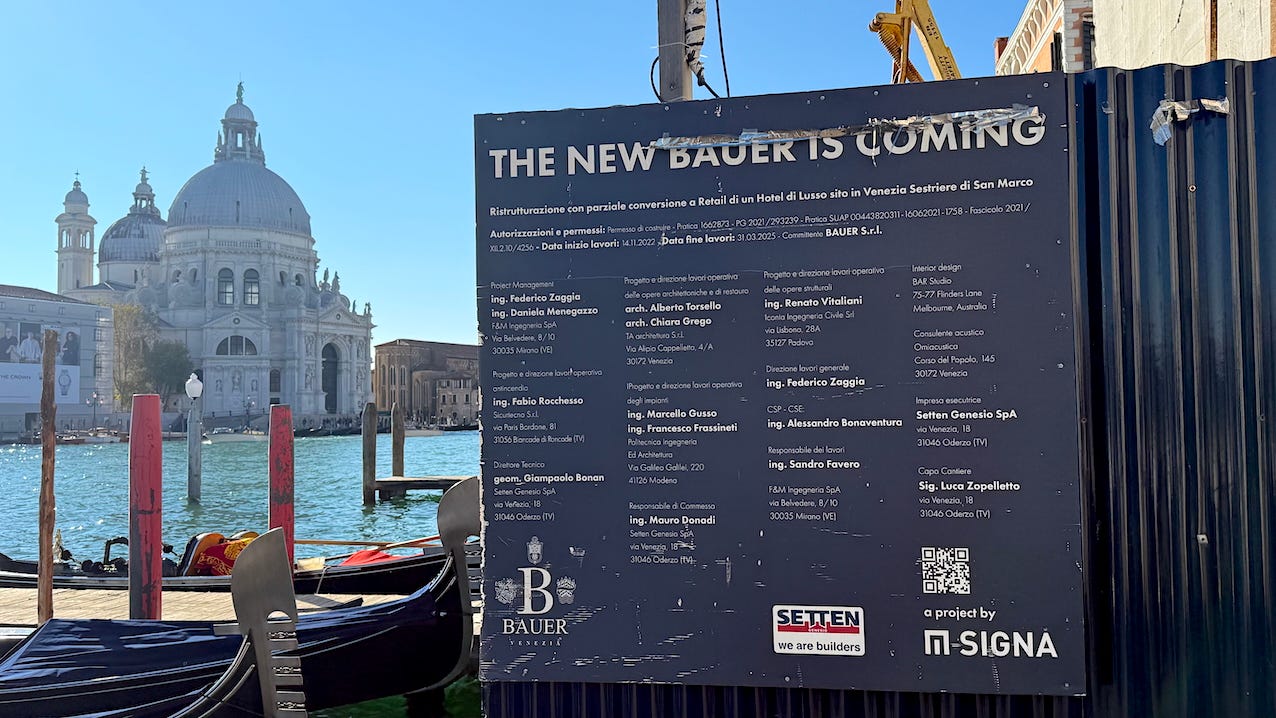
The office or headquarters is near St. Mark’s Square. You go down the small alley near Louis Vuitton towards the Grand Canal (if you come from Hermes or Chanel, turn left, from Prada or Valentino, turn right), directly opposite the Punta da Dogana. Not necessarily our favorite part of Venice. There is also a Biennale café by the water, l’ombra del Leone (the Shadow of the Lion). And a gondola harbor in front of it. Next to it is the construction site of the Hotel Bauer, with a large sign saying that they will be back. Last March.
The city of Venice provides public spaces such as the Giardini or Arsenale. Or palazzi that are still in their possession, while the Biennale Foundation organizes everything. If someone holds an event or exhibition somewhere that mentions the Biennale, they take great care to ensure that they are paid. It’s all well-rehearsed. Art and architecture are organized by the same people. Set-up, dismantling, transport. Understandably, they are quite strict. But also mostly overwhelmed. A lot of bureaucracy, lots of email accounts in cc. When Team Ratti, Carlo Ratti, messed up the organization with bots and AI during the preparations, the old hands stepped in neatly. (Mi scusi se ci faccio risparmiare un po’ di tempo.) Apparently, in the end, there was nothing but shouting. Was the explanatory app from SUB ever finished? We never saw anyone using it.
The president and board of the Biennale are appointed partly by the Italian Ministry of Culture and partly “in consultation with the local authorities of Venice, so that it is semi-autonomous but still bound to both the city and the state.” Hm, okay.


Pietrangelo Buttafuoco has been president of the foundation for a year and will remain so until March 2028. He is a journalist and writer whose grandfather was already a neo-fascist. He himself was also a leader of the Movimento Sociale Italiano (MSI), Mussolini’s successor party, and the Alleanza Nazionale. But Buttafuoco is somehow interesting. Not only has he written several novels and directed two theater festivals, but he has also converted to Islam. His name is Giafar al-Siqilli, just as Muhammad Ali was actually named Cassius Clay, and Yusuf Islam was Cat Stevens. As we said, Buttafuoco is interesting. At times, Islam was a challenge for his political career. After the MSI became AN in 1995 and the AN merged with Berlusconi’s Il Popolo della Libertà (PdL), Buttafuoco joined the Lega Nord, which had previously been allied with the AN. Giorgia Meloni, today prime minister and at the time a prominent member of the AN and the PdL, is said to have rejected Buttafuoco’s attempt to run as the Lega Nord’s candidate for governor of Sicily in 2015. The candidacy of a Muslim would send the wrong signals. Buttafuoco is more quiet on the topic now and wants to become prime minister himself.
In addition, the vice president of the Biennale is an old acquaintance who is less interesting: Luigi Brugnaro. Primarily an entrepreneur and, since 2015, mayor of Venice. He is facing charges for buying a piece of land cheaply, then changing the laws and reselling it at a high price. Really high. Brugnaro is chairman of his own party, Coraggio Italia. He’s probably not a fascist. Just corrupt. And somehow ridiculous. Prince Carnival. Venice deserves someone else. Or needs someone else. Very much so. Also on the Biennale board is Luca Zaia, a long-time member of the Lega Nord and currently president of the Veneto region. Although he is in the Lega (like Buttafuoco), Matteo Salvini’s fascist party, Zaia is sometimes good for surprisingly moderate or even progressive remarks. We don’t know much about Tamara Gregoretti. She has also been on the board since last year. Although, she was appointed by the Italian Minister of Culture. Does that say enough?
Perhaps Giafar al-Siqilli, Giafar the Sicilian, is so interesting because we know a few things about him, but so much remains unknown. He comes from Sicily. He emphasises the Muslim history of Sicily and took his new name in honour of Jafar ibn Muhammad, the conqueror of Syracuse in 878. He studied philosophy in Catania. And at some point he became a traditionalist. Traditionalism assumes that a single original, metaphysical truth is the source of all major world religions. There are many different interpretations, a lot of esotericism, mysticism, to which all religions can be traced back, but always gloomy. There is a lot of anti-Americanism. But essentially, as we understand it, in its more progressive forms it is a critique of modern society for its libertine individualism.
It is unclear when Buttafuoco became a traditionalist, but in 2001 he published a collection of his articles entitled Fogli consanguinei (Blood-Related Pages) with Edizioni di Ar, a publishing house named in honour of the Gruppo di Ur, to which Julius Evola once belonged. The philosopher who stood trial in 1951 for glorifying fascism, denied being a fascist and described himself as a ‘Superfaschista’. After the Second World War, Evola became the most important ideologue of the Italian radical right. His philosophy is anti-egalitarian, anti-liberal and anti-democratic. New Age spirituality and complete rejection of modern society.


Pietrangelo Buttafuoco has published at least one novel or collection of essays almost every year since 2002. Islam plays a role in several of them. His first novel, Le uova del drago (The Dragon’s Eggs), published in 2005, is set in Sicily during the war. The dragon’s eggs were eleven Muslim militiamen of various nationalities under the command of the Grand Mufti of Jerusalem. They fought alongside Italian fascists and a glamorous German spy against the Allied invasion. L’ultima del Diavolo (The Devil’s Last Woman) from 2008, which Buttafuoco called “the first Muslim novel in Italian,” alternates between the time of the Prophet Muhammad and the present. The devil is after documents about the monk Bahira because he wants to prevent Muhammad’s Christian legitimisation. The devil. And the Americans are allied with the devil. Alexander Dugin might like it. Or perhaps he prefers Cabaret Voltaire. L’Islam, il sacro, l’Occidente (Islam, the Sacred, the West) from 2008. Buttafuoco’s most traditionalist book. It attacks modernity and the allegedly false worship of rationality and science, as well as the illusion of freedom and democracy. Islam is misunderstood because of the ‘falsely liberal’ and American-dominated press.
Then came a completely different book about women and how to seduce them: Fìmmini. Ammirarle, decifrarle, sedurle (Women: Admire them, decipher them, seduce them). Okay.
And in 2011, Il lupo e la luna (The Wolf and the Moon), in which a young Sicilian is captured by the Turks and raised by the Sultan as a military commander. Later, he returns to Sicily and comes into conflict with his strict Catholic brother. That was the end of his strongly Islamic phase. Only Il feroce Saracino. La guerra dell’Islam. Il califfo alle porte di Roma (The Ferocious Saracen: The War of Islam, The Caliph at the Gates of Rome) from 2015 deals with terrorism. As a struggle within Islam. Good and bad Muslims. And then there is Sotto il suo passo nascono i fiori. Goethe e l’Islam (Flowers bloom beneath his footsteps: Goethe and Islam) from 2019. With Francesca Bocca-Aldaqre. It is about J.W. von Goethe’s encounter with Islam, which ends with his (alleged) conversion. The title is a line from Mahomet’s Song (1817/21).
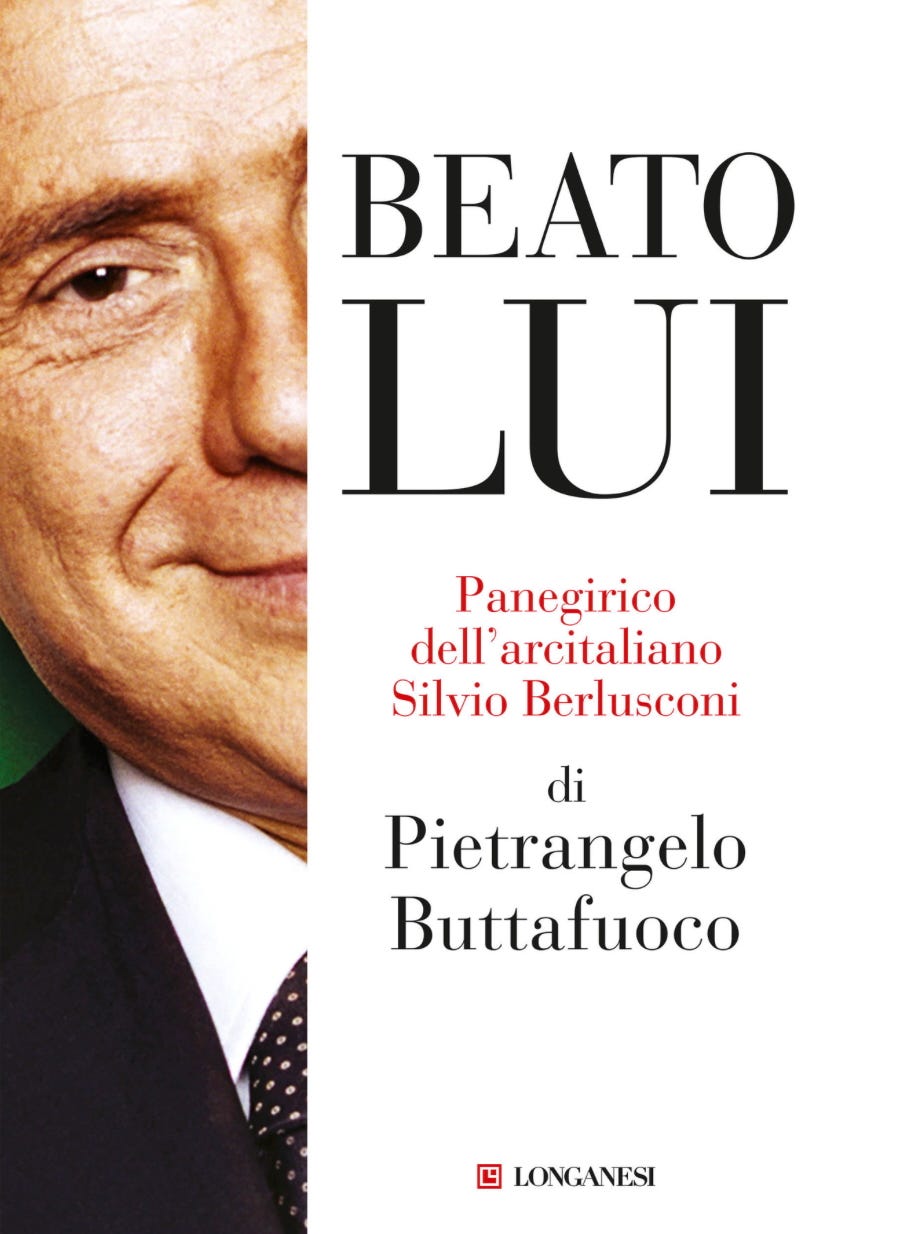
Buttafuoco was never known outside Italy. His novels have not been translated. Here he was known from television (Canale 5). And for his daily column in Il Foglio. From around 2010 onwards, his criticism of the centre-right and Berlusconi grew. This culminated in December 2012, after Berlusconi’s resignation, in a page in la Repubblica: “...Berlusconism, which ended in an incredible failure after the avant-garde and the archetypical Italy. In strategy, tactics and vision. The only legacy Silvio Berlusconi has left behind is ultimately that of a destroyed right wing.” That was also the end of his column. He had turned against his own people, and they now called him a ‘fascist Islamist,’ a ‘leaflet journalist’ whose novels had never been reviewed. Later, he wrote a book about Berlusconi, which reads almost like irony. Berlusconi, the embodiment of consumerism and individualism. And does Pietrangelo Buttafuoco like football?
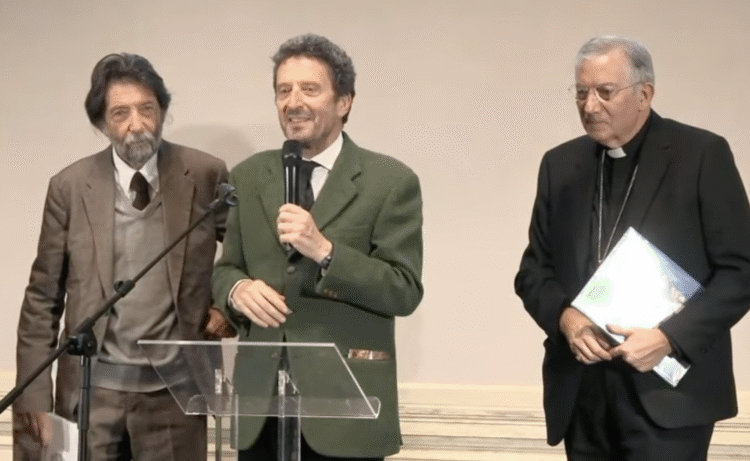
Two weeks ago, on November 7, President Buttafuoco presented in Venice a new series of events: la Biennale della Parola. The keynote speaker was Massimo Cacciari, the philosopher and former mayor of Venice whom we described in the last issue.
“Nothing will ever be the same again once the fundamental principles of your culture have been destroyed.” This sombre statement by Cacciari kicked off the event. And it was introduced by the Patriarch of Venice, Monsignor Francesco Moraglia. The title: The Death of Jus Belli. Wars and Peace. Immanuel Kant, Ernst Jünger, Carl Schmitt. It was probably a cheerful evening.
Europe would lose its legal and moral roots, the future generation would have to establish a new international law. And President Buttafuoco’s message was that the Biennale must be a ‘guardian of freedom.’ There it is again, that word: ‘freedom.’ Topics such as war and peace, which nowadays were almost taboo (really?) in public debate, must be discussed again. And Buttafuoco interesting enough recalled a Catholic, Giorgio La Pira, and a Communist, Pio La Torre. La Pira was mayor of Florence and helped draft the Italian constitution after the war; La Torre was a member of parliament from Palermo and was murdered in 1982, by his main opponents, the Mafia.
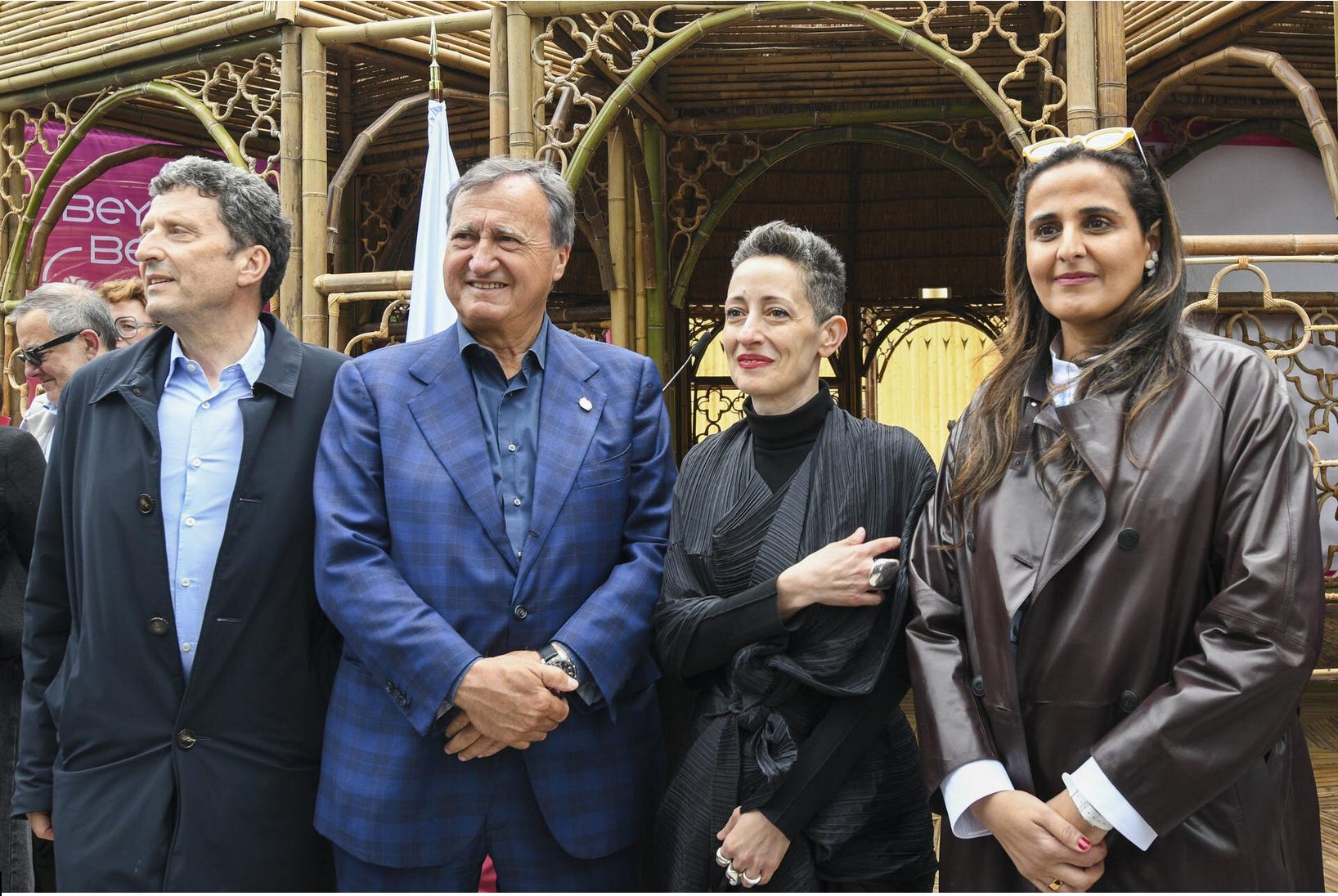
“The Biennale works in the service of the word,” Buttafuoco said on November 7, “and we are proud of what we achieve every day in our work.”
What do words matter when Bahrain wins the Golden Lion? When the United Arab Emirates, –now admittedly the main culprit in the Sudan war–have a pavilion? In 2021, at the 17th Architecture Biennale, the UAE won the Golden Lion for Wetland. Qatar? Gets its own pavilion in the Giardini. Right at the entrance. For money. What good are these words?
That’s it for today. Next time it’s number 31. And after 32, we take some time off! Ciao fioi, a presto!