

Issue 29: Dolphins Don’t Laugh
Mimmo, Mimmo Paladino, Mimmo Rotella, Massimo Cacciari, Chiara Patriarca, Alessandro Carrera, Egon & Diane von Fürstenberg, Barry Diller, Zohran Mamdani
The Unlikely Guide un-stacks the Venetian lagoon every week and celebrates it in all its complexity. It’s a declaration of love to the local people, to the fish, the artichokes, to the Lido, to Murano, to Sant’Erasmo, and to the mud. It is composed under various headlines and features science fiction, fiction, Biennale reports, and the History Channel with stories and myths from the lagoon.
Here we go, Number 29 :
about this and that (weddings)
Ciao! Have you heard about Mimmo? A cheerful dolphin that has been splashing around in the middle of the lagoon for several weeks now. Between San Giorgio Maggiore and St. Mark’s Square. The dolphin is said to have lost his way. They have named him ‘Mimmo’, the diminutive form of Domenico, which in turn means ‘belonging to the Lord.’ Walter Benjamin once wrote that animals look so sad because humans give them names. There is a great deal of concern for the bottlenose dolphin. delfino Mimmo@Facebook: “Let’s save Mimmo”. “The dolphin swimming in St. Mark’s Basin: he must return to the open sea!” “Venice is mobilizing to save Mimmo.” Or great headlines like: “Venice, Mimmo, and the tourists’ big misunderstanding: dolphins don’t laugh.” Why not?
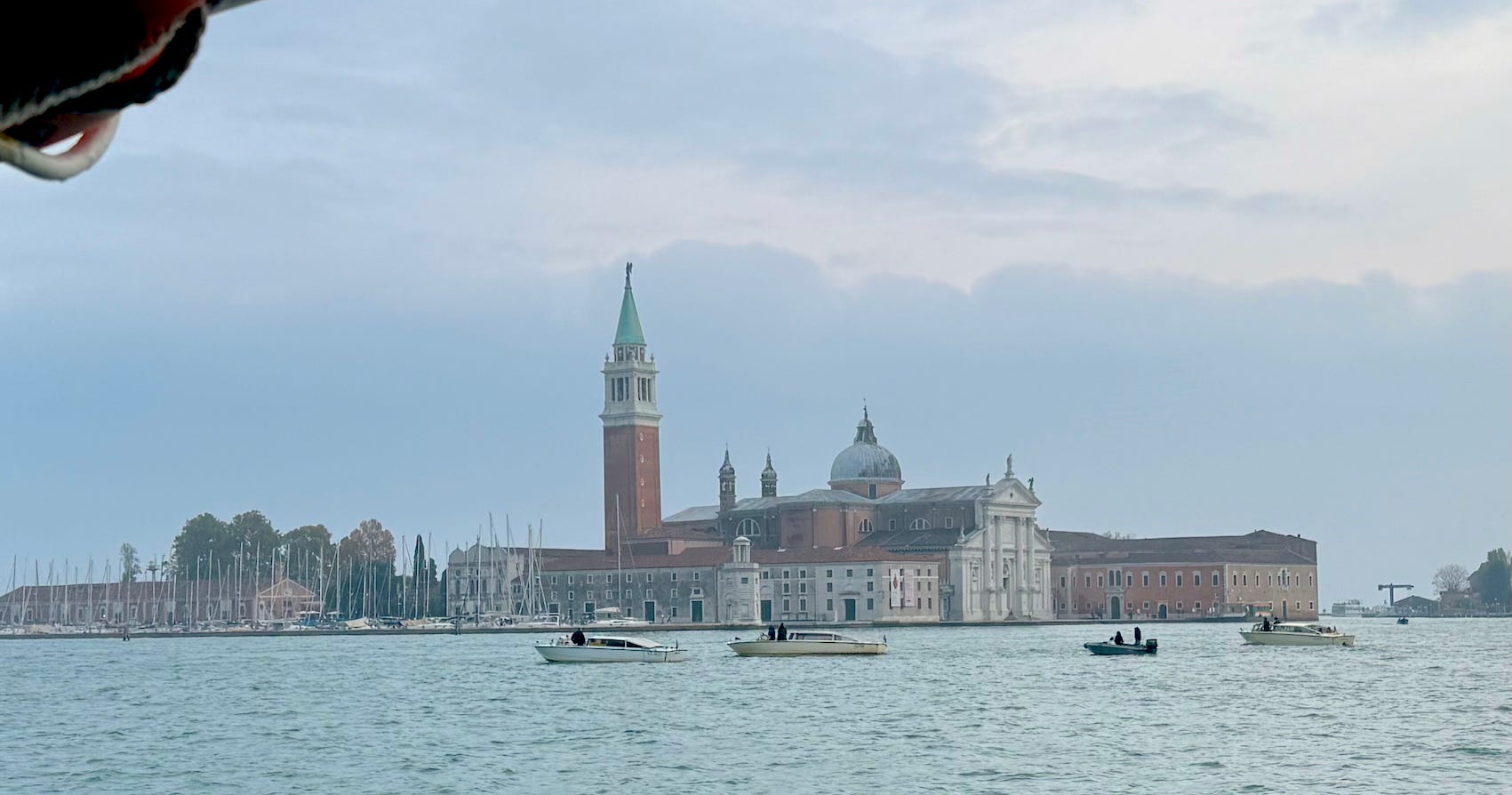
During the pandemic, images of dolphins in the canals appeared everywhere. With no ships moving around and the lagoon actually very clean, dolphins were said to be everywhere. That wasn’t true, but it was somehow a positive ‘as if.’ And it convinced a few people that there are too many ships here. Too many large ships. Too many ships with deep drafts. Warnings about them are now also being issued in connection with Mimmo.


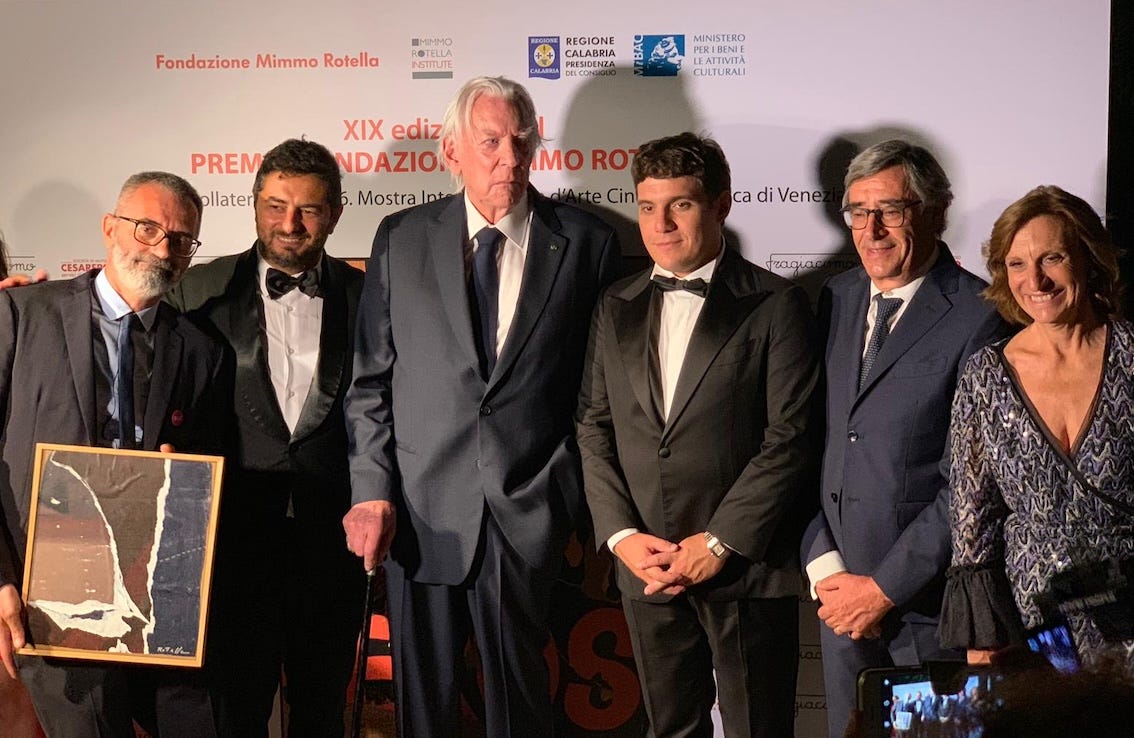
Why Mimmo, actually? Mimmo Paladino? A famous artist who created the Italian pavilion at the Biennale in 2015. But he has nothing to do with dolphins. More with horses. And then there’s Mimmo Rotella, an artist who made poster tear-offs. In the tradition of the Cubists. Movie posters were torn off, revealing other posters underneath. He invented the technique. It’s called ‘decollage.’ Some tigers and very often Marilyn Monroe can be seen. In 1964, he was invited to the Biennale. In his honor, or perhaps to promote his hometown of Catanzaro in Calabria, the Mimmo Rotella Prize is awarded annually at the Mostra, the film Biennale. To a director and an actor. Donald Sutherland has been given it, as have Al Pacino and George Clooney. Oliver Stone has also won it. But so far, no dolphin has.
“The risk of ‘uncontrolled’ tourism.” Despite calls for caution, taxi boats of course offer tours to take selfies with Mimmo. Some try to lure him with balloons or food, which is totally idiotic. And the ship’s propellers are obviously a threat, while the noise of the engines can impair its ability to orient itself. And to communicate with other dolphins. If there are any. Mimmo seems to be quite on his own. The coast guard and the CERT – Cetacean’s Stranding Emergency Response Team in Legnaro have been observing Mimmo from the beginning. He eats regularly and shows normal swimming and breathing movements. And they plan to accompany him to the open sea. Where he belongs. In a flock.
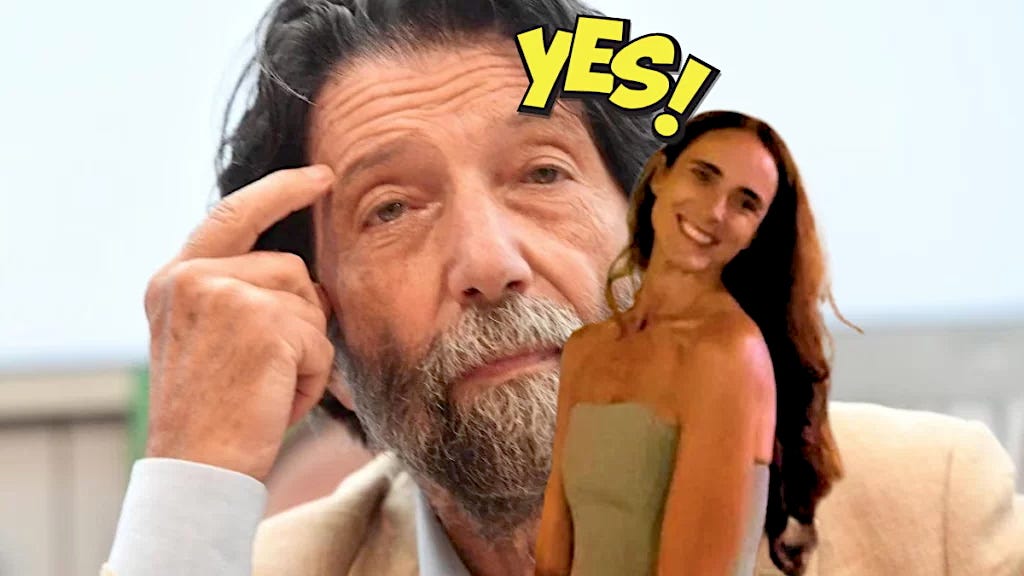
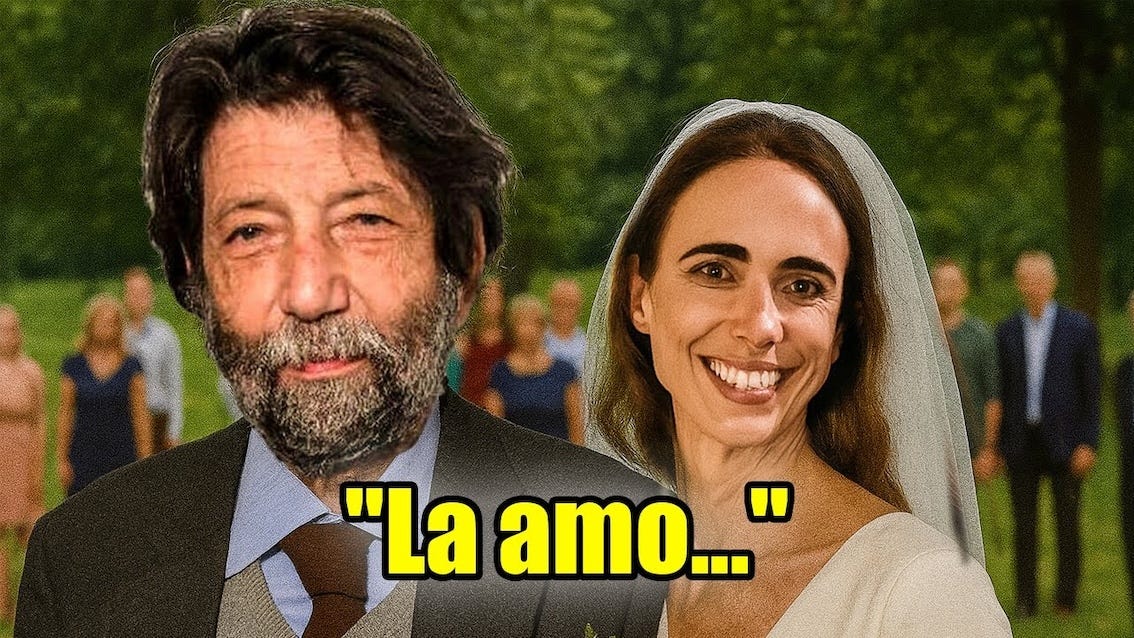
Posters have been put up in the municipalities of Venice and Milan about the marriage: The Groom is born in Venice in 1944, resident in Venice. The bride, Chiara Patriarca, is born in Trieste in 1973, resident in Milan. Massimo Cacciari is an academic philosopher and a high-profile intellectual in contemporary Italy. AND: he was the mayor of Venice from 1993 to 2000 and from 2005 to 2010. Yes, Venice once had a good mayor.
Massimo Cacciari taught at the University of Architecture in Venice in 1970/71, where he met Manfredo Tafuri. In 1980, he was given a permanent position, and in 1985, he was appointed to the field of aesthetics. In 2002, he founded the Faculty of Philosophy at the University of Milan. At the same time, from 1998 to 2006, he was director of the Faculty of Philosophy at the Academy of Architecture at the University of Lugano. When he was young, Massimo Cacciari was, of course, a communist. In principle, a Eurocommunist. And soon provincial secretary of the chemical workers’ union. From 1976 to 1983, he was a member of parliament. In 1984, after the death of Enrico Berlinguer, he left the PCI.
In 1993, Cacciari became an independent candidate for the left-wing Alleanza dei Progressisti (Alliance of Progressives) and was elected mayor of Venice with 42.3% of the vote in the first round and 55.4% in the runoff. In 1997, he was re-elected in the first round with 64.6%. Supported by Romano Prodi’s L’Ulivo (The Olive Tree), a broad center-left alliance. Cacciari became a leading figure of Centocittà (one hundred cities), a network of mayors. Centocittà merged with the social-liberal I Democratici in 1999. In the same year, Cacciari was elected to the EU Parliament for the I Democratici and resigned as mayor. He was considered a contender for something bigger at the time, but was defeated in 2000, in the race for the presidency of Veneto by Berlusconi’s Forza Italia candidate. Cacciari gave up his seat in the EU Parliament and became a member of the regional parliament. In 2005, he made a surprise announcement that he wanted to become mayor of Venice again.
Cacciari’s political career also shows how the left, centrists, and right have constantly split, united, and reformed. In this election, he ran against former prosecutor Felice Casson, who was backed by the social democratic DS, the communists, and the Greens. Behind Cacciari was the social-liberal Democrazia è Libertà – La Margherita, into which his I Democratici had merged or been absorbed. In the first round, the former prosecutor Casson won 37.7% and Cacciari only 23.2%. It looked like defeat. But then he had a 1,300-vote lead in the runoff and won with 50.5%. It was a complicated coalition of the center and the left, and by 2009 he was fed up. He wanted to return to the university and not run again in 2010. His successor was Giorgio Orsoni, who surprisingly won the election against Berlusconi’s candidate.
Shortly thereafter, Massimo Cacciari presented the manifesto Verso Nord, un’ Italia più vicina (Towards the North, a closer Italy), which was aimed at those who were disappointed with both the Partito Democratico (actually the successor to Prodi’s Olive Tree, now led by Elly Schlein) and the Popolo della Libertà (Berlusconi 2009-2013, a merger of Forza Italia and Alleanza Nazionale) but also distanced from the Lega Nord. In October 2010, the Verso Nord party was founded. Then things became increasingly confusing with splits and the founding of Future Italy, Verso la Terra Repubblica (Toward the Third Republic) (VTR), and Mario Monti’s Scelta Civica (Civic Choice). No joke.
But during all this time in active politics, during all the elections, struggles, ups and downs, Massimo Cacciari wrote philosophical and political essays, authored books, and also processed what he had just learned.
Alessandro Carrera, an Italian poet, essayist, and songwriter, is the editor of the English translation of Cacciari’s 2009 book The Unpolitical. He has written a beautiful and very inspiring introduction to it. Carrera explains how much Cacciari thinks about the city, but also how he uses the uniqueness of Venice as an archipelago, as ‘two cities’ (Mestre and the historic center), as an explanation or template for Europe and the world.
In another essay, ‘Venezia possibile’ (Possible Venice, 1989), he had already tried to connect the threads of his philosophy to Venice. What does ‘Save Venice!’ mean, Cacciari asks? The cry is so old because the very existence of Venice has always been exceptional. For centuries, the geopolitical order of Europe has seen nothing more unnatural than Venice’s government, ruling class and power. During the eighteenth century, however, Venice lost the capability of representing itself to the eyes of the world. The subsequent transformation of Venice into a tourist attraction coincided with the universal cry of ‘Save Venice!’ addressed to no one in particular. But Venice is a living organism, and not, we may say, the European franchise of the Las Vegas version of itself (when the Venetian Hotel opened in Las Vegas, Cacciari was invited as the mayor of the ‘real’ Venice; he obviously declined). (…)
At the end of Italo Calvino’s Invisible Cities (1972), Marco Polo is having his usual conversation with Kublai Khan. This time he is about to say something that he has never admitted before. The hundreds of strange cities that he has described to the emperor were just the masks of Venice. In his reports to the emperor, Marco Polo evoked no other city than Venice. Cacciari’s theoretical, political, and literary essays have traveled a long way, but Cacciari’s writing, in its ambitious totality, perhaps has no other desire than to be the written metamorphosis of Venice’s thousand patterns.”Carrera’s Introduction to The Unpolitical by Massimo Cacciari, 2009
As mayor, you automatically become president of the Fondazione Teatro La Fenice and vice president of the foundation for the Biennale. Cacciari (who also wrote libretti for his friend, the composer Luigi Nono) naturally mastered these tasks brilliantly, while the current mayor comes across as rather clueless and amateurish. This is evident in the dispute at La Fenice, in all the decisions surrounding Qatar’s new pavilion, and at the Bezos wedding. Those who pay or have power are waved through, no matter how damaging it is to Venice.
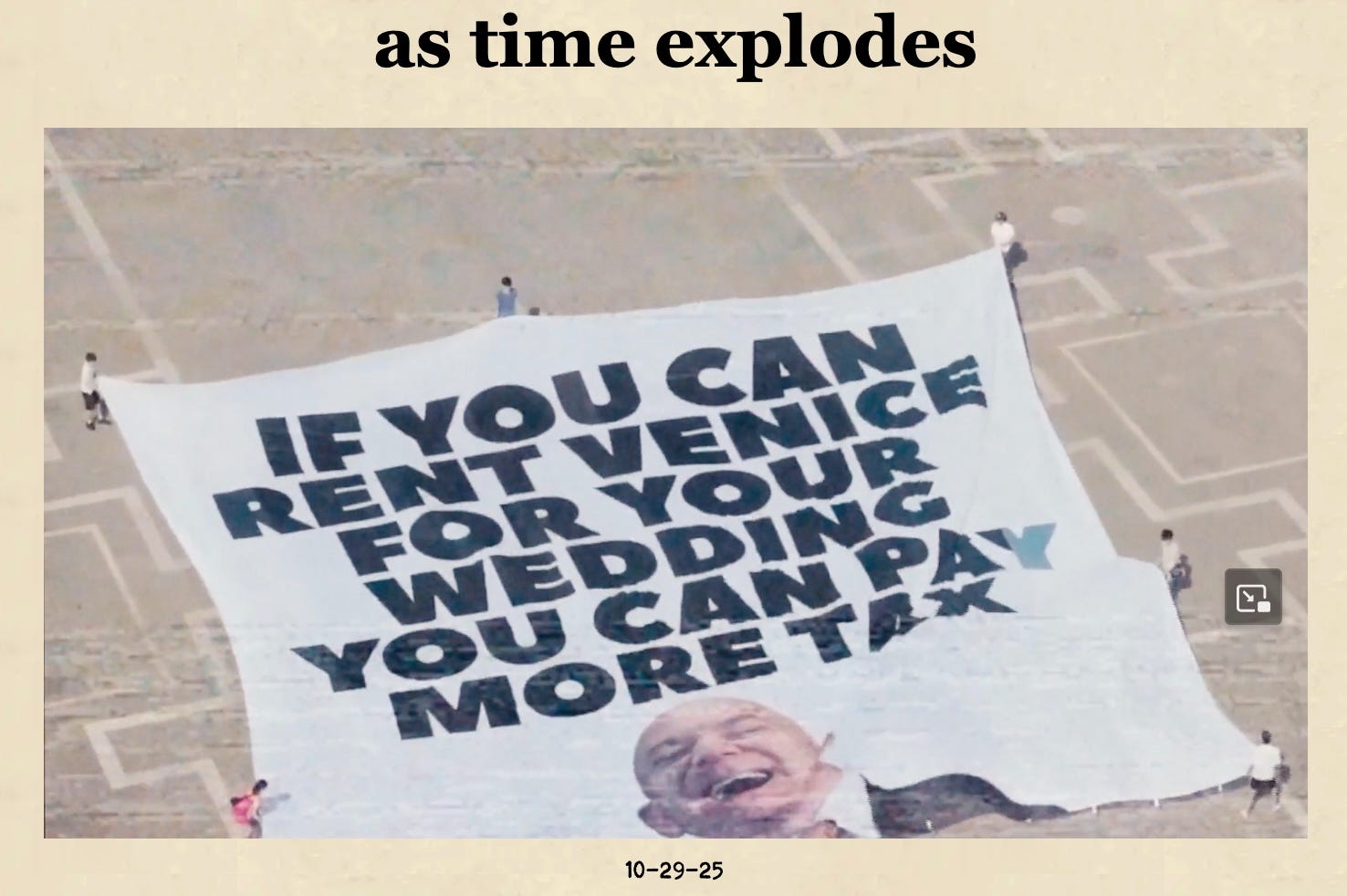
Thanks to the protests here, Jeff Bezos’ wedding has become a symbol of the obscenity, excess, and shamelessness of the wealthiest 1%. And Venice is becoming a symbol of total commercialization, corruption, and venality. This is what Cacciari and architectural historian Manfredo Tafuri always warned about. But it’s not just Bezos alone, it’s his guest list and especially people like wrap dress inventor Diane von Fürstenberg, who are supposedly Venetians, surely love Venice and are trying to ‘save’ it. But then help Bezos justify and cover up his utter shamelessness. With supposed investments and donations. They are only saving themselves. The curator of the 19th Architecture Biennale, Carlo Ratti, invited von Fürstenberg to make a contribution: “… Diane von Fürstenberg will explore how Venice can turn its femininity into resilience.” The result is a few flags along the promenade in the Giardini leading to the main pavilion, which is currently undergoing renovation, and a booklet. This is full of Venice kitsch, certainly well-intentioned, “Venice is female,” and there are all kinds of goddesses presenting Venice’s great inventions.


Von Fürstenberg was the much-coveted It couple in New York in the 1970s with her husband Egon. So she should really know better. In 1973, Linda Francke published a malicious article in New York Magazine in which she described the von Fürstenbergs as “New York’s reigning glory couple.” But then wrote that Prince Egon and Princess Diane (the title came from 15th-century Germany, the money from Egon’s mother Clara Agnelli from the Fiat fortune) would claim to be 26 years old: “He looks like it, she doesn’t!” according to Francke. And then there’s their emptiness, their promiscuity (’Egon von First-in-bed’), and their shamelessness: Euro-trash!


That was too much for Diane, and she divorced the Prince. At that point, she already had two children and was a famous fashion designer. Later she married Barry Diller, the billionaire who founded Fox News with Rupert Murdoch and became an important and wealthy media mogul with Tele-Shopping or companies like Expedia, and Vimeo. New York is the other island city that has become too expensive for ordinary locals. People like Andrew Cuomo, Michael Bloomberg, and Barry Diller don’t care about that. They call themselves Democrats, but they don’t really want to pay taxes. And anyone who advocates for more justice is woke. Or ultra-left. Powerful PACs fighting Zohran Mamdani in the mayoral race have just raised over $40 million. And in line with election filings, Barry Diller has made substantial donations to a committee called ‘Repair the Metropolis,’ (haha) which certainly supports Andrew Cuomo. The elections are tomorrow. We’ll see if it has made a difference. Diller also defended his “very, very dear, loving friend” Jeff Bezos for undermining the Washington Post’s endorsement for Kamala Harris. And they came here to his wedding. Diane connected local artisans, such as the exclusive Murano glassmakers ‘Laguna B,’ and did some charity work. Ma non basta!
And that’s it for now, and next time it’s number 30, the third critical one!
Ciao fioi, a presto!
As a long-time resident of Venice, I (like many other Venetians, for that matter) would strongly question the statement “Yes, Venice once had a good mayor”: Venice's sell-out began when Massimo Cacciari, a former communist and media darling known as the “philosopher mayor,” discovered the blessings of the free market. Converts always tend toward extremes, so it's no surprise that Cacciari promised as early as 1994 to remove all obstacles for investors and their projects. This can be read in the brochure “Privatizzare Venezia” (Privatize Venice) – subtitled “The urban planner as entrepreneur” – which sounds like a neoliberal manifesto. It promised Venice a golden future if the city entered into a lifelong alliance with banks and international companies: the largest cruise port in the Mediterranean, expansion of the airport, endless large-scale projects – more, more, more.
The fact that Cacciari's vision also included the contamination of the lagoon with highly toxic biocides from ship hulls, the destruction of Venice's fragile shores as a result of the pressure of thousands of tons of water, electrosmog from radar systems, particulate matter pollution, and an officially recognized “significant increase in lung tumors” was accepted as collateral damage. Mayor Cacciari presented privatization to the Venetians as the only way to lead this city, stubbornly rooted in its past, into a bright future, which is why the Venetians were not surprised when the long-standing mayor and his city planning department head suddenly proclaimed the need for a new bridge over the Grand Canal. The enigmatic bridge to the train station was built for the Benettons. It is intended to channel the flow of visitors from Piazzale Roma directly to Benetton's own railway building and Benetton's own train station, where another large shopping center has been built. And there is much more to say about Cacciari, who is only highly praised as the so-called “philosopher mayor” in the eyes of the German-speaking press.