

Issue 34: No!
"It’s still breathing!"
The Unlikely Guide un-stacks the Venetian lagoon every week and celebrates it in all its complexity. It’s a declaration of love to the local people, to the fish, the artichokes, to the Lido, to Murano, to Sant’Erasmo, and to the mud. It is composed under various headlines and features science fiction, fiction, Biennale reports, and the History Channel with stories and myths from the lagoon.
Here we go, Number 34:
The Lock-In-Effect
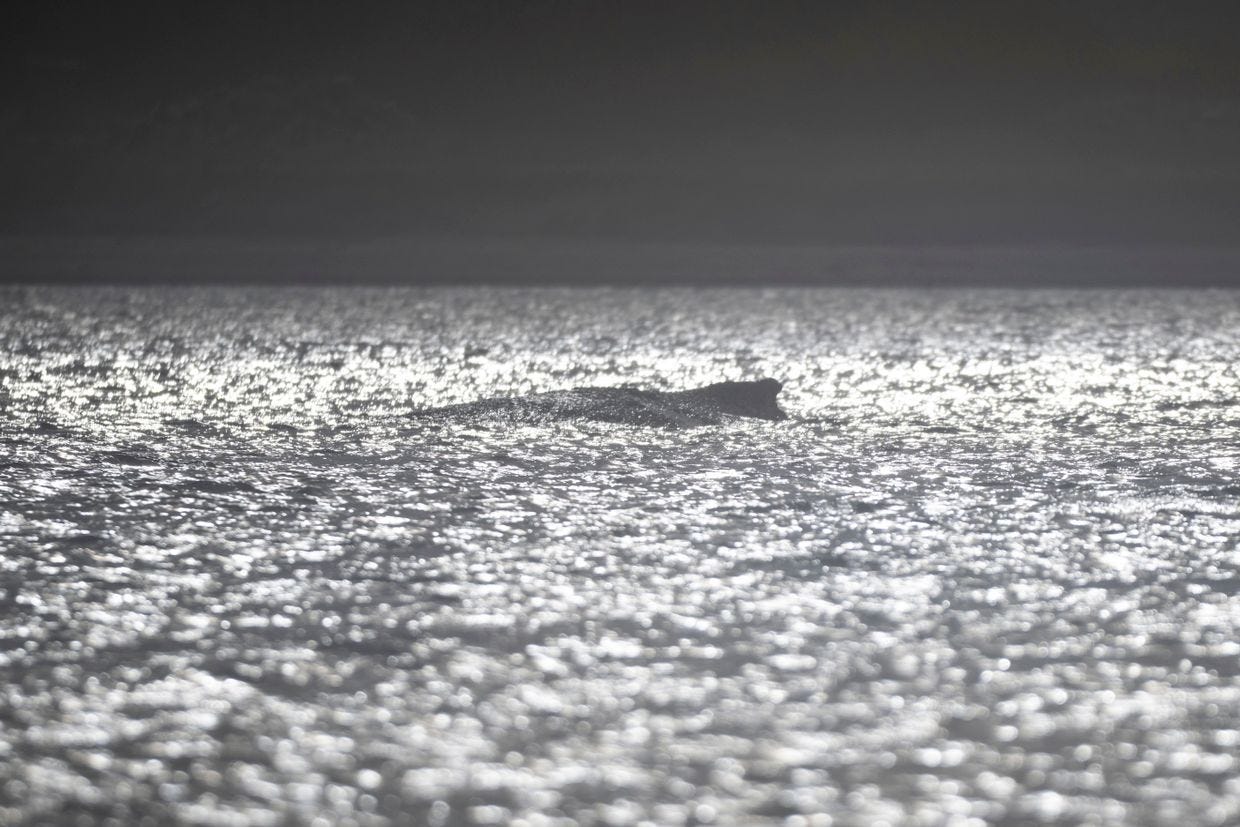
Just half an hour ago, the humpback whale in the Baltic Sea ran aground on a sandbank for the third time. The fool. And so he is increasingly becoming a metaphor for the world. For politics, for democracy, for Europe, for the West. For the Left, for Italian football, for Italy itself, for Germany, for France, for opera, for cinema, for the Biennale, … Or simply a mirror. Everyone can identify with Timmy. Come on! Go on, swim! Get a move on, get going! Pull yourself together. Fat pig. Get up! Just like in the army. Or at the gym. Or on TikTok. 15 minutes a day is enough for a six-pack! No, can’t be bothered. Not enough salt. It’s lovely here. On the sandbank. And now a seagull’s perched on my back. So what?
The whale is different from the cheerful dolphin in the lagoon. Remember? Where is it, actually? What was its name again? Mimmy, Mummo, Mambo? But the whale is far more interesting. It’s still breathing! Most of the time. Two hours ago it was nowhere to be seen. For a bit. Hopefully he is going to make it! To the North Sea. How? Where is that anyway? He didn’t look well. Why? What does a whale that looks well look like? In any case, he’s magnificently melancholic. The Marcello Mastroianni of the seas. Mumbo wasn’t like that. He was just a dolphin. And Mumbo wanted to. Timmy doesn’t. That makes him more contemporary. Humpback whales aren’t even endangered. Eels are endangered, sturgeons are endangered. But humpback whales, not really. Probably because nobody eats whale. Except the Japanese. Sorry, of course.
What on earth has become of the Biennale? That old whale. Haven’t heard a peep from it in ages. Run aground? Older readers may recall that the Moby Dick of the art world invited the Russian Pavilion. Or rather, allowed them to come. President Buttafuoco has manoeuvred himself onto a huge sandbank giving La Repubblica a completely ludicrous interview. We reported on that. In which he plays the peacemaker and spouts some very cynical nonsense. That we no longer have enough Latin scholars. That would be the downfall of the West, or the world. Just as his kindred spirit Alexander Dugin says that the Russian kids’ blockbuster Cheburashka would be “the epitome of the kind of nonsense I have spent my whole life fighting against.” The crocodile, in particular. Buttafuoco & Dugin hate the West. They hate modernity. They hate America (even before Trump… even before Richard Nixon. Even before Christopher Columbus!) They believe in Eurasia. It’s all hard to understand; in fact, the traditionalists themselves don’t really understand it. They are, in any case, vain, conceited hyper-intellectuals. Not whales. More like eels. Or sturgeons. But not victims either. Perhaps some invasive sunfish. In any case, the President said everyone was welcome. Quite a few people disagreed. Including Russian dissidents. People in prison. Pussy Riot. The oppressed. The Ukraine. That makes dialogue very, very difficult. But Matteo Salvini has come to Buttafuoco’s aid. They’re in the same party. Salvini said sport and art are free. Really? Hahaha. The very old among us will still remember that Salvini was a fervent supporter of Vladimir Putin. He’d briefly forgotten this himself…


In Leviathan (1651), Thomas Hobbes wrote that rulers (the sovereign) are obliged to prevent wars. Because people, by nature, would start wars. And if the ruler prevents wars, he has absolute power over the people. If not, he can go to hell. He derives his power not from God, but from his actions. The book was also seen as a justification for parliament. Leviathan is a chaotic sea creature from the Hebrew Bible and earlier mythologies, which had to be tamed by a social contract.
The Happiness Report 2026 has just been published. And once again, the Scandinavians come out on top. Finland, Denmark, Norway, Iceland. Although one might think that it’s dark there for half the year and they get senselessly drunk like in Aki Kaurismäki films. Serotonin deficiency, bad skin, bad moods… No! Time and again they come out on top. Of course: little corruption, fairly high levels of security, fairly wealthy. Ice bathing. But, most importantly: they believe in the state. They trust in elections. They believe that somehow they’ll manage it. And that they’ll be helped. That they won’t end up living on the streets in the end. That’s how democracy works. Democracy is simply not a community of values. Because values are subjective. Like morals and ethics. Instead people vote and assume they’ll be able to vote again in four years’ time. Possibly for the same candidate. In Turkey, for example, that’s not possible because the opposition candidate is in prison. One can learn a great deal about this from the very Federal Republic-esque, that is, West German philosopher Jürgen Habermas. Like Alexander Kluge, he seemed to be a rather cheerful person. Unlike their teachers at the Frankfurt School. Habermas, however, was also difficult to quote, yet a towering champion of parliamentary democracy.


Mr Habermas and Mr Kluge have both passed away in quick succession. This is a great loss.
The lock-in effect is a term from the housing market. Tenants or homeowners whose children have moved out cannot move to a smaller flat because these have become much more expensive in the meantime. Nor can they afford the larger one anymore. At the same time, families having children cannot find a larger flat. It’s far too expensive, too. Whether to buy or rent. So people stay put until they’re broke. Until they have to leave. Until they starve. Not enough salt.
So much for the market. Few people rent here. And the situation is even worse because there are far too many holiday flats in Venice. People from Germany, Austria, Switzerland or simply wealthy Italians with part-time spaces. Empty in winter, sometimes rented out during the Mostra and the Biennale opening.
Lock-out effect: Young Venetians can only buy or rent in Mestre. If at all. Or leave. Drain. Brain drain. The old folks mostly vote for the far right. So that nothing changes. Sandbank. Very little salt.
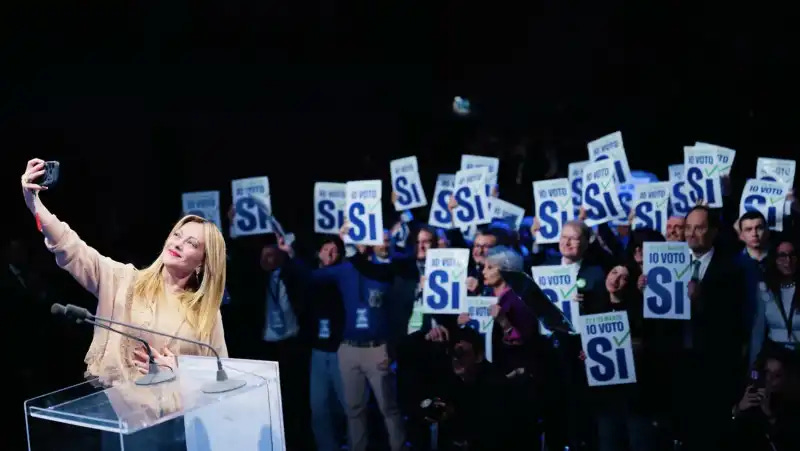
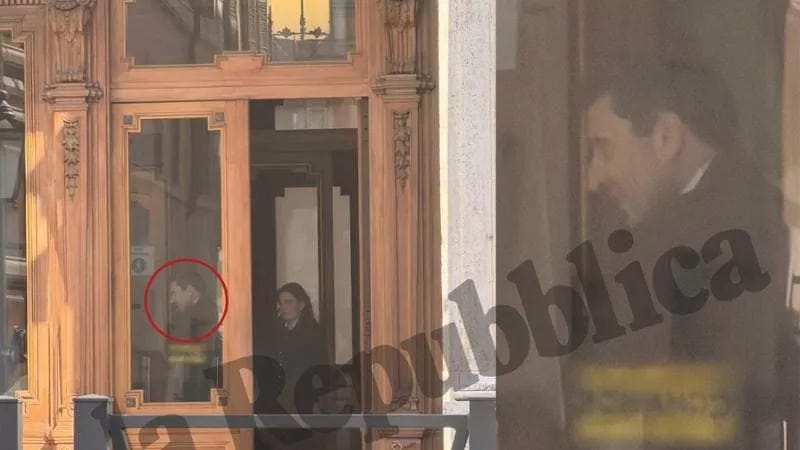
Oh yes, and then there was the referendum. One of the flagship initiatives of Giorgia Meloni’s government. They wanted fewer ‘left-wing’ judges. Politicians should have much more say in who is allowed to become a judge or prosecutor. Their own people, in other words. Just like in the cultural sector. (Not only in Italy, but also in Germany, with Wolfram Weimer, and with Rachida Dati in France, there are now cultural politicians with little sympathy for culture but facing allegations of corruption) But since nobody understood what the referendum was actually about, it boiled down to right versus left. Yes! versus No! Because they didn’t understand it themselves. Because they believe they can do everything better. “My sister!” Oh, I see. Of course the judiciary needs to be much faster and less bureaucratic. Take the example of Luigi Brugnaro, the mayor of Venice. He has been under investigation since 2022 for “systematically pursuing personal interests”, and in May last year the Venice Public Prosecutor’s Office asked the investigating judge to bring him and the other 33 suspects to trial. And then?


Si! (i.e. Meloni) has lost. No! has won; the constitution won’t be changed. And as I write this, Italy is losing the match against Bosnia and Herzegovina on penalties. First a red card, then the levelling goal, then the penalty shoot-out in which goalkeeper Gianluigi Donnarumma crumpled up his Bosnian counterpart’s cheat sheet. Just imagine if they’d won? Because of the crumpled piece of paper? And afterwards, Donnarumma got angry. Because the Squadra Azzurra didn’t win. No! That means Italy won’t be at the World Cup for the third time in a row. Maybe in 2030. Children here will turn 16 without ever having seen a World Cup in which their team played. What does that do to the country?
The 2026 curator, Koyo Kouoh, wanted a quiet Biennale, one of nuances. Not the constant, loud ‘Yes! No! Good! Evil!’ dichotomies. Just shades of grey, subtle tones. Complex, difficult situations. Situations, not constellations. Like music. A brilliant concept these days, with the lovely title In Minor Keys. That must have appealed to the supposedly so profound President Buttafuoco. Engage with music! With silence. With the intermediate tones. Then curator Koyo Kouoh died. She can no longer comment on any of this. Where, actually, is her team that is continuing the project? Buttafuoco has taken over, explaining what art may and must do, and what it cannot and will not do. Salvini does the same. The Minister for Culture, Alessandro Giuli, has opposed Buttafuoco. Different party. That doesn’t make the Minister for Culture any better.
The Squadra Azzurra needs a complete makeover. The Meloni government will drag itself to the next election, stop holding referendums, run aground on several sandbanks and then try to win with plenty of lies and selfies. And what about Timmy, the humpback whale in the Baltic Sea? Attempts to rescue him have been abandoned. He will probably die a slow death. And the Biennale? This year will be Alberto Barbera’s last film festival. Perhaps the Biennale should also completely reinvent itself. More salt. No party members. Away from the market. Away… Ciao ragazzi, see you soon! With #35. And don’t forget: Mumbo, Mumbo!
remark on "still breathing":
"L'ordre de l'architecture, qui libère à son sommet le figure de la danse impose sur le sol ses règles et sa géométrie aux hommes disciplinés. Les colonnes du pouvoir. << Bien >>, disait un jour le grand-duc Michel devant qui on venait de faire manoevrer les troupes, << seulement, ils respirent. >>2 Michel Foucault, L'EXAMEN, in: II. LES MOYENS DE BON DRESSEMENT, in: Surveiller et punir, Naissance de la prison, Gallimard, Paris, p.190
2 Kropotkine, Autour d'une vie, 1902, p. 9. Je dois cette référence à M. G. Canguilhem.,
orig. in english 1899, USA Houghton Mifflin, UK Smith&Elder
remark on Hobbes:
the biblical and often mentioned Leviathan is accompanied by the lesser mentioned Behemoth. The title of the first and only book published in the US exile by a member of the Frankfurt School: Franz Neumann, Behemoth. The Structure and Practice of National Socialism, 1933 - 1944, https://www.bloomsbury.com/us/behemoth-9781566638197/
available online in the copy of the L.B.S National Academy of Administration, India:
https://archive.org/details/in.ernet.dli.2015.236979/mode/2up
remark on Moby Dick:
"Woe to him who seeks to please rather than to appal!“ Herman Melville, The Sermon, chapter 9, Moby Dick (1851)