

Issue 18: Smart Refusal
John Lin and a peep show that never ends, Bernard Rudofsky's labyrinth where you shouldn't look for the exit. Felicity D. Scott, Count of Castell-Rüdenhausen, Nicholas Negroponte.
The Unlikely Guide un-stacks the Venetian lagoon every week and celebrates it in all its complexity. It’s a declaration of love to the local people, to the fish, the artichokes, to the Lido, to Murano, to Sant’Erasmo, and to the mud. It is composed under various headlines and features science fiction, fiction, Biennale reports, and the History Channel with stories and myths from the lagoon
Here we go, Number Eighteen:
Rudofsky
Ciao! Last Tuesday, while patrolling the Arsenale once again, we ran into John Lin, a Taiwanese architect who teaches in Hong Kong. Along with a group of people from various countries, continents and disciplines, he had erected a rather funny-looking, round, wooden shed in the Biennale’s 'Collective Intelligens' section. Next to Bjarke Ingels' delicately and neatly carved ornaments – executed by two monks and a robot arm – it looks like the future cathedral in a Martian favela. Around this inverted spaceship are boxes on the floor made of used wood. You are supposed to step on them or sit down and look into the holes at different heights. At first, people didn't understand, John Lin told us, until they borrowed a lipstick and drew big arrows pointing to the holes. But before we go any further, here is our guide for the week:
The fact that you have to look through peep holes to see people makes it a nice piece. And it tells us something about this Biennale. Because it is analogue and linear, the world turns before our eyes (the title is ‘Carosello’) with all its cycles: people are born and people die. The phone's battery is at 18%, but will soon drop to 5%. Then it will be charged again. On the top of Carosello's three levels, we see a romantic, dark landscape with an old aeroplane flying overhead and lights burning in underground houses. Animals are standing in the snow or under a tree in spring. The level below shows scenes from the life of a woman who was born in an underground house. She marries, moves away, and then returns because of floods. She reports on life in underground houses on TikTok, becoming a star in the process. On the lowest level, there are models of various traditional Chinese houses. Again, the focus seems to be on the people and their sense of community. In the famous Tulou houses, for instance, the communal kitchens in the inner courtyard are meeting places for all residents. Sometimes it almost seems as if Lin and his collaborators Lidia Rățoi, Davide Spina, Kaiho Yu and Christopher Roth had deliberately cut things out sloppily, deliberately disregarded the proportions so that nobody could get the idea that it wasn't all made by humans. And the Carosello turns a bit fast ... or does it?


John Lin, our Unlikely Guide, mentions Bernard Rudofsky and his 1964 exhibition Architecture Without Architects at the Museum of Modern Art in New York. This show featured photographs of pre-industrial and vernacular buildings, with Rudofsky praising the ingenuity and spontaneity of the unknown self-builders:
There is much to learn from architecture before it became an expert's art. The untutored builders in space and time–the protagonists of this show–demonstrate an admirable talent for fitting their buildings into the natural surroundings. Instead of trying to "conquer" nature, as we do, they welcome the vagaries of climate and the challenge of topography.
Berhard Rudofsky, A Short Introduction to Non-Pedigreed Architecture, 1965
Rudofsky's approach does not seem to be a nostalgic celebration of pre-industrial ways of life, but he is rather an early representative of degrowth. Who is questioning solutionism and consumerism. And eurocentrism? During the planning phase, Rudofsky wrote to various colleagues asking for examples: “I am not thinking of a documentation of folk architecture, but of anonymous buildings (or details) that the camera may have transformed into something unique...” However, the architects were not very helpful, so he had to rely on collections, archives, tourists, and amateurs. The first thing that striked us was that there are hardly any people in the photographs (again!). Often, the focus is on how the buildings relate to each other rather than on individual buildings. How the images relate to each other. The caption for the underground houses in ‘Architecture Without Architects’ reads: “Dwellings below, fields upstairs: One of the most radical solutions in the field of shelter is represented by the underground towns and villages in the Chinese loess belt. Loess is silt, transported and deposited by the wind (…) about ten million people live in dwellings hollowed out from loess."
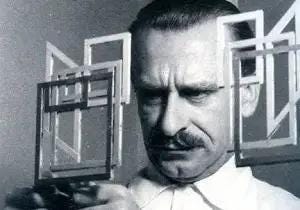
Rudofsky was born in 1905, in Moravia (now part of the Czech Republic), which at that time belonged to the Austro-Hungarian Empire. He grew up in Vienna. After completing his dissertation in 1931, he moved to Capri and then to Naples, where he worked with Luigi Cosenza. In 1936, he completed Casa Oro before moving to Milan at the invitation of Gio Ponti to work for Domus.
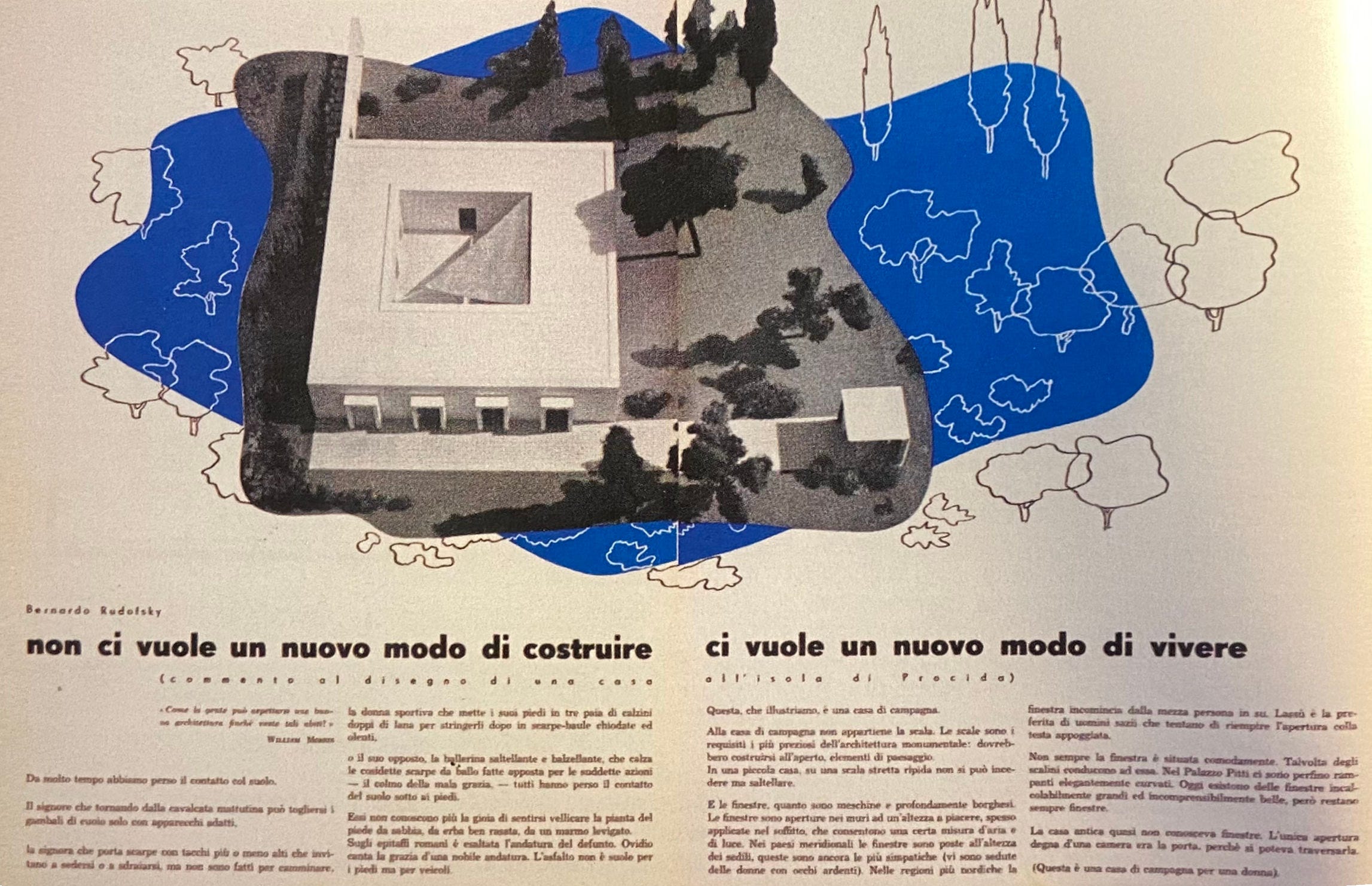
After the annexation of Austria by Nazi Germany, Rudofsky fled Europe for Latin America in 1938, and settled in São Paulo. There he designed a number of villas and shops.


In 1941, he traveled to New York without a passport under the name Bernardo Rudofsky. When the United States entered the war, he was classified an ‘enemy alien’ but was granted citizenship in 1948. Rudofsky now became (in the traditional sense) an architect without architecture. With the exception of La Casa, a house in the neo-vernacular style that he designed for himself and his wife Berta near Málaga in Spain in 1969, his work was now mainly exhibitions, photographs, and publications.
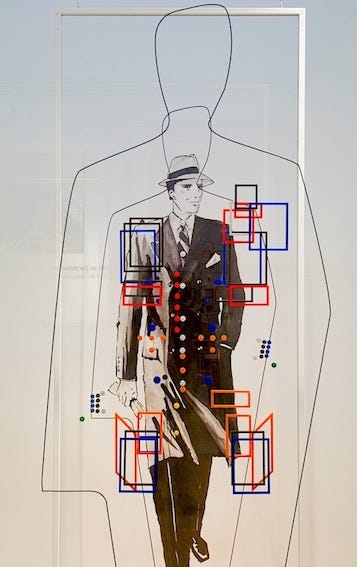
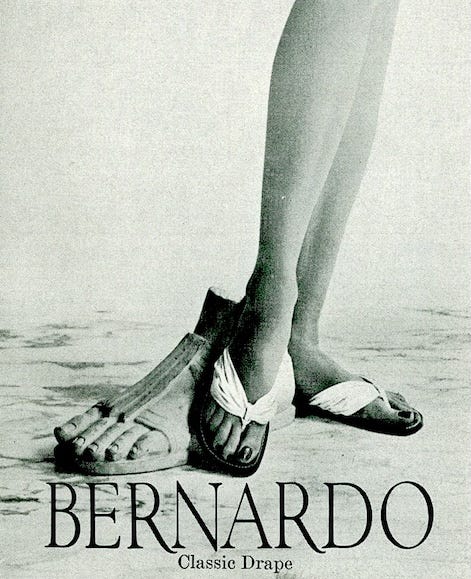
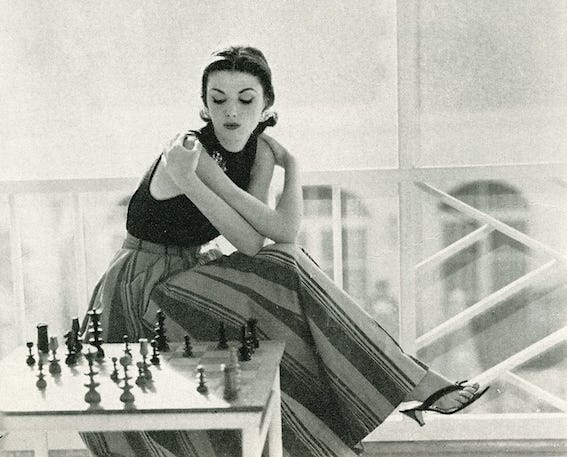
The first major MoMA show organized by Rudofsky was ‘Are Clothes Modern?’ in 1944, in which he called Western fashion “irrational and uncomfortable.” Parallel to the exhibition, Rudofsky launched his brand Bernardo Sandals Inc. The practical manifestation of the show. Simple, functional, and timeless shoes.
In the 1969 show, ‘Streets for People: A Primer for Americans,’ (again at MoMa in New York) Rudofsky argued for pedestrian-friendly living, squares, and a vibrant street culture. In car-friendly America.
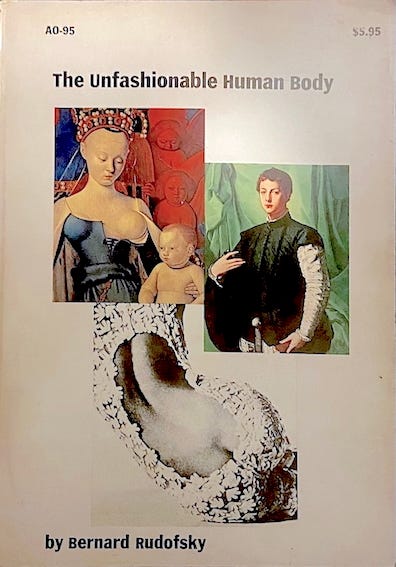
‘Now I Lay Me Down to Eat: Notes and Footnotes on the Lost Art of Living’ comes out in 1980. A book about sleeping, bathing, and other physical practices. How design influences everyday life and how architecture could realign with it. With the everyday life. Not with monumental forms.
In her wonderful book ‘Disorientation: Bernard Rudofsky in the Empire of Signs,’ Felicity D. Scott describes how Bernard Rudofsky realized his own projects in the 1920s and early 1930s with a largely humanist and regionalist, if clearly modernist, mindset, but "his mobilization of images and his spectacular recontextualization of those images in the 1960s more often served to offer parodies or allegories of modern architecture in a state of decline." She calls his approach deliberately obscure and disorienting: "Instead, he formulated tactical openings within the logics of a labyrinthine realm, seeking indeterminate relationships, illegible surfaces, and even, literally, a lack of focus.” A labyrinth where you shouldn't look for the exit.


The photographs of the underground houses in ‘Architecture Without Architects’ are taken by Wulf-Diether Count of Castell-Rüdenhausen in 1935, 30 years before Rudofsky’s New York exhibit. Castell had come to China in 1933 as a Lufthansa pilot and was to build up a network for the newly founded Eurasia Aviation. He explored new routes, flew freight and mail and sometimes important passengers. The Chinese called the planes ‘German birds’. In the late 1920s, the Berlin-Moscow-Beijing route was agreed, but could not be realized for political reasons. The Soviets were in charge in Moscow, Adolf Hitler came to power in 1933 and a civil war was raging in China, in which Chiang Kai-shek's Kuomintang, supported by Germany, was fighting against Mao Zedong's Communists, backed by Josef Stalin. And in 1937, the Second Sino-Japanese War broke out. Castell stayed for three years and in 1938 published ‘China Flight’, a book with many of his photographs. He remained a civilian pilot and never joined the NSDAP, (the Nazi Party).
Carlo Ratti, the Curator of the 19th Architecture Biennale Intelligens, also mentions the Manameh Pavilion and Terra Preta from the Living Lab section, which would "confront the legacy of Bernard Rudofsky."
Rudofsky deeply inspired Nicholas Negroponte, the founder of MIT’s Architecture Machine Group and later the Media Lab. In his book ‘Soft Architecture Machines,’ from 1975, Negroponte proposes design systems—like the 'Design Amplifier'—to enable non-expert users to shape their environments. There is a connection. And a piece from 1970 by Negroponte is in the Arsenale: ‘Seek’. But we couldn't find it. At first, we assumed that the sensory overload and inaccuracy of the show might relate to Rudofsky's 'Disorientation.' No. No, that's not it.
Although Felicity D. Scott accuses Rudofsky of „…retaining a problematic blindness— projecting ideas and racial stereotypes onto cultures and populations to which he had little access—and at times implicitly, if perhaps unwittingly, silenced cultural specificity.“ She concludes with the question whether he, “in his stubborn refusal of universal modes of communication, and in his tactical, bodily engagement, had in fact found a means through which to outwit, if only temporarily, emergent and globalizing systems of power?”
It's always a fine line, ragazzi, but we can learn a lot from Bernardo Rudofsky: a lack of focus, smart refusal, as well as, etc. Four important things for the future. Ci vediamo presto!
"etc.": and AND again
Yo sé de un laberinto griego que es una línea única, recta.
le prometo ese laberinto, que consta de una sola línea recta y que es indivisible, incesante.
(Jorge Luis Borges, La muerte y la brújula, in: Artificios, 1944; Ficciones, 1944)
„I promise you that labyrinth, which consists of a single straight line and which is indivisible, incessant.“ (Jorge Luis Borges, Death and the Compass, 1944)
Más información: La muerte y la brújula, cuento de Borges
https://www.apocatastasis.com/borges-la-muerte-y-la-brujula.php
© www.apocatastasis.com, por Henzo Lafuente
https://www.literatura.us/borges/lamuerte.html